
9:41
The thing is...
Great music stays buried because discovery depends on names, not feeling.
We're not here to compete with other platforms.
SoulSound turns discovery upside down.
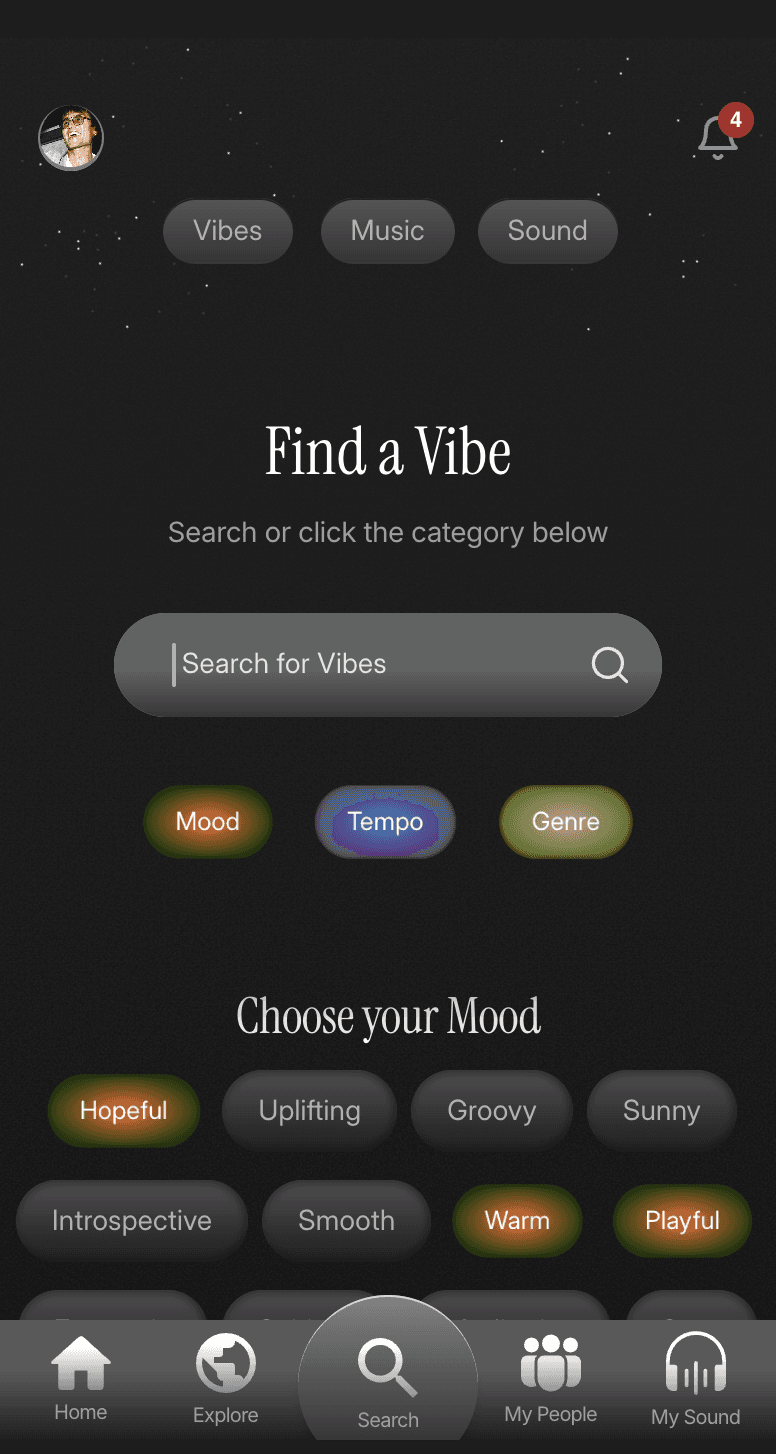
You don't need to know the song or artist.
You just need to know how you feel.
Search by mood, genre, tempo and energy — and find music that your body, mind or soul is truly asking for.
The long-term vision: the most accurate music experience in the world.
Human ears, artist knowledge, community wisdom - that's what we're building our library on. Three things algorithms don't have.
We are building an honest, AI-free music experience can truly match the high standards of even the pickiest music lovers out there.
The people who make the music available deserve to be paid fairly.
Because without it, our Souls wouldn't have gotten as far as we have. Many labels and artists aren't getting the reckognition and the spread they deserve.
We're building the platform to prove they do.
A new way of listening.
With soulful ease.


For Founding Labels

And in case you were wondering…
A music discovery and streaming platform built for the electronic music community. Instead of searching by artist name, you search by feeling — genre, mood, tempo, and energy — and find music that matches exactly where you are.
Mainstream platforms run on algorithms optimised for engagement, and discovery still depends on name recognition — if you don't already know an artist, you're unlikely to find them. SoulSound is built the opposite way. Every track is tagged by a human, not a model. An unknown artist with the right sound gets found as easily as one with a million followers. At its core, SoulSound exists to help artists and labels be discovered by people from around the world who would otherwise never have had a way of finding them — listeners whose taste matches exactly what you make, wherever they are.
Yes, always. You grant a non-exclusive license to stream your music on SoulSound. You retain full ownership. No exclusivity, no transfer of rights.
No. SoulSound is streaming-only. Tracks are never downloadable and never leave the app. Your files stay protected inside the platform.
At any time, no questions asked. If you ever want your music taken down, it will be actioned promptly.
Every track on SoulSound is tagged using an internally developed taxonomy across four dimensions: Genre, Mood, Tempo, and Energy. Genre is mapped down to its roots — tracing sound to its history rather than relying on modern, often diluted interpretations of what a genre label means today. Mood is set using methods drawn from film scoring and music psychology — the same thinking used to understand how music creates emotional states, applied here to describe how a track actually feels rather than what it's simply labelled as. Tempo and Energy are treated as two separate dimensions, because they answer different questions. Tempo is the pace — fast music for the body, measured in BPM and felt rhythm. Energy is the intensity — fast music for the brain, shaped by density, complexity, and emotional force, independent of BPM. A track can be slow in tempo but rising in energy, or driving in tempo but settled in energy. That distinction lets SoulSound surface music that matches not just how fast something moves, but how intense it actually feels. Every tag is applied personally by the SoulSound founder, using this system. If you disagree with any tag on your music, we'll discuss and revise it.
Permanent recognition on the SoulSound website, direct access to the founding team, real input into the platform's direction, and recognition for helping define what SoulSound sounds like from the very beginning.
No. Founding labels join by invitation during the beta phase. There's no cost to be part of it. And for users it’s free during Beta.
SoulSound is currently in a closed beta, so there's no revenue coming in yet and nothing is being monetised. SoulSound runs on subscriptions. Premium is free for everyone during the beta. After launch, new listeners get 30 days of free premium, followed by a free tier with ads (where listeners choose their own ad settings) and a paid monthly premium. Our payout model is built around rights holders first, covering both master and publishing, and rests on a few core principles: User-centric payouts. Each listener's money goes only to the music they actually listen to, not into one shared pool split by overall market share. Dedicated listeners of underground music directly support the labels and artists they love. Every stream counts. No minimum stream thresholds, so deep catalogues and smaller releases get paid in full. A fairer share. Our aim is to pay rights holders above the industry norm. One model for everyone. The same terms apply to every label, and the labels who join earliest are the first to benefit when revenue begins. We haven't set an exact payout percentage yet, and that's deliberate. We're still modelling the full picture, including pricing, app store fees and publishing costs.
SoulSound is focused on electronic music — from the deepest, most minimal corners of the underground, to community driven festival stages, and intimate forest raves or stripped-back warehouse parties. As the taxonomy and catalogue grow, SoulSound will naturally extend into other genres. But electronic music is the foundation, and it's being built first, properly, before anything else.
The platform for the
ones that create the culture.
I'm interested